
Do Taller Men Earn More? What a 120,000-Person Study Found
Share
Nobody puts "height" on a job application. There's no box for it on the form, and no interviewer has ever asked, "And how tall are you, roughly?" Yet the paycheck seems to know anyway.
The study: 120,000 people and a lot of DNA
In 2016, researchers at the University of Exeter published a study in The BMJ using data from around 120,000 people in the UK Biobank. They didn't only compare tall people with short people, because that alone proves very little. Taller people might have grown up with better nutrition, more money or healthier childhoods, and any of those could explain a bigger paycheck later.
So the team used a clever shortcut called Mendelian randomisation. In plain English, they looked at the genes that make people taller. You don't choose your genes, and your parents' bank balance doesn't pick them either, so they work a bit like a natural experiment.
The result: for men, being genetically inclined to stand about 3 inches taller was linked to roughly £1,500 (around $2,000) more in annual household income. Taller men were also more likely to hold a degree and to work in higher-status jobs.
A tape measure with benefits
$2,000 a year doesn't sound life-changing until you remember that it keeps happening. Every year. For an entire career.
An older and much-quoted study by Timothy Judge and Daniel Cable (2004) went further. Their estimate was that a 6-foot man would earn about $166,000 more over a 30-year career than a man standing 5'5", other things being equal. That's a very nice car, a decent chunk of a house, or roughly 1,100 pairs of good shoes. We're not saying which one you should choose.
Why would height pay?
Nobody is quietly measuring you in the lift. The researchers' best explanations are more human than that:
- First impressions. People tend to read height as confidence, competence and authority, often within seconds.
- Self-confidence. Judge and Cable suggested that part of the effect comes from how tall people see themselves, and how that shows up in negotiations, meetings and interviews.
- A head start that compounds. Small advantages early on, such as being picked to lead a school project or being noticed first, can add up over decades.
The fine print (and yes, we read it)
It's worth being honest about what this does and doesn't mean.
- The figure is household income, not personal salary.
- These are averages across large groups. Plenty of shorter men out-earn plenty of taller men, and talent, work and luck still do most of the heavy lifting.
- No study has shown that wearing taller shoes gets you a raise. If your boss asks why you deserve one, "my Chelsea boots" is not a strong answer.
What the research does suggest is that how you carry yourself gets noticed. Standing a little taller, and feeling it, is one of the easier things to change about a first impression.
The easy part
You can't change your genes. You can't go back and eat more vegetables at age 9. But you can walk into Monday's meeting 2 to 3 inches taller, and nobody needs to know how.
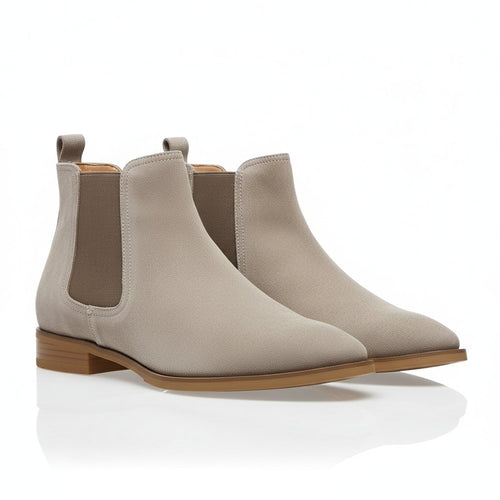
Every pair of 6FT Club shoes has the lift engineered directly into the sole and footbed. It isn't a removable insert, it doesn't slide around, and it doesn't show when you take your shoes off. They look like regular shoes, just from slightly higher up.
Shop all shoes
Sneakers, dress shoes and boots with 2 to 3 inches of hidden lift, and a 30-day fit guarantee.
Sources
- Tyrrell J. et al. (2016). Height, body mass index, and socioeconomic status: Mendelian randomisation study in UK Biobank. The BMJ, 352:i582.
- Judge T.A. & Cable D.M. (2004). The effect of physical height on workplace success and income. Journal of Applied Psychology, 89(3), 428–441.